Colombia's labor calendar is notable for its frequent long weekends, a phenomenon explained by the Emiliani Law (Law 51 of 1983). This regulation established a rule to move the celebration of most existing holidays to the following Monday, thereby guaranteeing three consecutive days of rest, locally known as puentes (bridges), and increasing opportunities for tourism and rest throughout the year.
This article explains and compiles all relevant information about the Emiliani Law, including how it works, its history, impact, and controversies.
Quick Summary
- Official Name: Law 51 of 1983.
- What is it?: The law that moves 10 public holidays to Monday to create long weekends.
- Shifting Rule: If the holiday falls between Tuesday and Sunday, it moves to the following Monday. If it falls on a Monday, it stays.
- Applies to 10 holidays: Epiphany, Saint Joseph's Day, Saint Peter and Saint Paul, Assumption of Mary, Day of the Race (Columbus Day), All Saints' Day, Independence of Cartagena, Ascension of Jesus, Corpus Christi, and Sacred Heart.
- Important: Not all holidays are moved; there are 8 fixed dates that are immovable.
Application of Holiday Shifting
According to Article 1 of Law 51 of 1983, it is established that for 10 of the 18 public holidays, "when they do not fall on a Monday, they shall be transferred to the Monday following said day." It clarifies that when the date of one of these holidays is a Sunday, "the paid rest day shall likewise be transferred to Monday."
| Holiday Type | Day of the Week | Celebration |
|---|---|---|
| Movable | Other than Monday | The following Monday ➡️ |
| Movable | Monday | That same day |
| Fixed | All | That same day |
The 10 Movable Holidays
These are the days that will always move to the following Monday, "Emiliani Holidays," unless they already fall on a Monday:
- Epiphany (Three Kings' Day): January 6.
- Saint Joseph's Day: March 19.
- Saint Peter and Saint Paul: June 29.
- Assumption of Mary: August 15.
- Day of the Race (Columbus Day): October 12.
- All Saints' Day: November 1.
- Independence of Cartagena: November 11.
- Ascension of Jesus: Variable date, 39 days after Easter.
- Corpus Christi: Variable date, 60 days after Easter.
- Sacred Heart: Variable date, 68 days after Easter.
The 8 Fixed-Date Holidays
These days are celebrated on their exact calendar date, regardless of the day of the week. They are also known as "Immovable Holidays."
- New Year's Day: January 1.
- Labor Day: May 1.
- Independence Day: July 20.
- Battle of Boyacá: August 7.
- Immaculate Conception: December 8.
- Christmas: December 25.
- Maundy Thursday: Variable date, Thursday before Easter.
- Good Friday: Variable date, Friday before Easter.
Raimundo Emiliani Román
Raimundo Emiliani Román (1914-2005) was the senator from Cartagena who promoted Law 51 of 1983 and acted as the manager and rapporteur of the project. Due to this central role, the rule began to be known colloquially as the "Emiliani Law."
A lawyer from the National University and a member of the Laureanista wing (followers of Laureano Gómez) of the Conservative Party, he had a broad public career: civil circuit judge of Cartagena (1939-1943), Representative to the Chamber (1945-1947), Minister of Labor (1957-1959), Minister of Justice (1965), Senator for more than 20 years (1962-1982), and member of the National Constituent Assembly of 1991.
In addition, he developed a diplomatic career with missions as minister plenipotentiary (Uruguay, 1951-1952; Cuba, 1953) and ambassador (Switzerland, 1959-1961, and to the Holy See, 1979-1980).
In the academic field, he was a professor of Civil Law (National University and Sergio Arboleda University) and author of several books, including Derecho de las obligaciones (Law of Obligations). His legislative legacy transcends long weekends: he was a driving force behind the creation of SENA (National Learning Service) (through Decree-Law 118 of 1957), a promoter of Family Compensation Funds (Cajas de Compensación), and a defender of equal rights for children born in and out of wedlock.
Origin and Context
Law 51 of 1983 sought to reduce interruptions in the workweek that affected work continuity. The measure was presented as a way to organize productive activity, improve planning for both companies and workers, and strengthen domestic tourism and family integration.
The bill began its processing and discussion in 1982; Congress definitively approved the law on December 6, 1983, and it was sanctioned by the president on December 22. The first "Epiphany long weekend" under the new regulations was celebrated in January 1984.
Main Motivations
- Productivity and work organization: Avoid holidays "splitting" the week and affecting the rhythm of production, with operating costs and difficult decisions for companies.
- Rationalization of breaks: Regulate a widespread practice of taking additional non-holiday days to extend breaks, which generated informal closures and economic losses.
- Domestic tourism and commerce: Accumulate rest days on long weekends to favor travel and consumption in activities associated with tourism, transport, and hospitality.
- Rest, recreation, and labor welfare: Reinforce paid rest as a component of labor protection and recreation, beyond the exact date of each celebration.
The Productivity Problem
Before 1983, when a holiday fell on intermediate days of the week (for example, Tuesday or Thursday), the appearance of "informal bridges" was frequent: Monday or Friday was taken as additional rest, creating four-day weekends without a clear legal framework. The Constitutional Court recognized in 1994 that this situation caused "substantial losses, by paralyzing industry and commerce on a day that was not a holiday."
Furthermore, in industrial sectors with continuous processes, stopping operations on an isolated day could generate additional costs when restarting. In frequently cited examples, such as the textile sector, stopping machines on an intermediate day implied a loss of time and raw material for the next day's startup. In practice, many companies ended up between two costly options: stopping production or assuming additional payments to sustain a partial operation.
The Presidential Veto of 1982 and the Solution with the Church
The first holiday shifting bill was approved by Congress in 1982, but President Belisario Betancur vetoed it for two reasons: it increased the effective days of rest and, crucially, the Catholic Church had not been consulted on the transfer of religious festivities, a necessary requirement given the Concordat in force between Colombia and the Holy See.
The solution came in July 1983. The Episcopal Conference of Colombia, in its XXXIX Plenary Assembly, eliminated several religious holidays from the mandatory calendar and issued a "Pastoral Instruction on the occasion of the new Calendar of religious holidays in Colombia" on July 14, 1983. The Holy See granted the rescript of recognitio (Prot. N. 171292/I) on July 12, 1983, allowing the project to move forward.
Labor Implications
The holiday shifting system has direct consequences on labor rights and obligations, for both employers and workers. The law establishes that all labor effects are recognized on the transferred day, not on the original date of the holiday.
The Emiliani Law directly modified Article 177 of the Substantive Labor Code, incorporating the list of holidays and the transfer mechanism. Other relevant articles of the CST are:
- Article 172: Establishes the employer's obligation to provide paid Sunday rest.
- Article 179: Regulates remuneration for work on mandatory rest days (modified by Law 2466 of 2025 with progressive surcharges).
- Article 180: Contemplates compensatory rest when it is not possible to grant rest on the holiday.
Premium Pay for Holiday Work
When working on a holiday transferred to Monday, the premium pay for working on a public holiday applies to that Monday, not to the original date. Article 1, paragraph 3 of Law 51 of 1983 is explicit: "The benefits and rights that work on public holidays originates for the worker, shall be recognized in relation to the established paid rest day."
For example, if the Epiphany holiday on January 6 falls on a weekday and is moved to the following Monday, the right to premium pay for working applies only on the following Monday, not on January 6, which is considered a business day.
In the public sector, there is a 100% surcharge plus a compensatory day when working a public holiday, according to what is established in Decree 1042 of 1978, Article 39.
In the private sector, the surcharge is in a process of progressive adjustment. Law 2466 of 2025 (Labor Reform) modified Article 179 of the Substantive Labor Code, establishing a progressive increase in premium pay for work on public holidays:
| Period | Premium Pay on Ordinary Salary |
|---|---|
| Until June 2025 | 75% |
| July 2025 - June 2026 | 80% |
| July 2026 - June 2027 | 90% |
| From July 2027 | 100% |
Economic Impact
Since the late 1980s, amidst economic and social changes in Colombia, taking advantage of long weekends began to normalize. Various sources began to report the positive impact on the tourism sector, highlighting an increase in hotel occupancy and informal trade during weekends that were previously considered low seasons.
Similarly, the transport sector reported increases in both inter-municipal trips and domestic flights.
For many years, data from ANATO and COTELCO have shown that long weekends generate significant increases in hotel occupancy and domestic tourism, compared to regular weekends.
In addition to the indisputable benefits for the tourism and transport sector, long weekends have also favored other economic sectors, such as retail and gastronomy, which experience increases in sales and consumption during these periods.
In contrast, in some sectors a negative effect is presented, especially due to the interruption of production, the increase in operating costs, and the difficulty in maintaining continuity in productive processes. Even so, the impact on productivity in some sectors has not been as negative as initially feared. For example, in the financial sector, it was observed that the decrease in operations on long weekends was compensated by a significant increase on the following business day.
Social Impact
The increase in long weekends thanks to the Emiliani Law tends to strengthen family and social bonds when they become opportunities to visit and gather. According to data from this BBVA Research report, the most common reason for residents' trips within Colombia is visiting relatives or friends (47%) and the majority of travelers stay in the homes of family or friends (57%), reflecting that the additional free time indeed favors personal bonds.
By generating blocks of several consecutive days of rest, long weekends are a factor associated with emotional well-being and work-life balance. They also help mitigate the lack of free time to travel, which is the second reason (after economic reasons) why Colombians do not travel within the country.
With the large number of long weekends, participation in cultural and religious celebrations is also facilitated, which contributes to preserving customs and reinforcing cultural identity.
The Productivity Debate
The debate on the impact of the Emiliani Law on labor productivity has been constant since its implementation. In addition to the clear benefit for some sectors and affectation for others, there are multiple factors that extend the analysis.
According to human resources leaders, the rest generated by long weekends can contribute to greater motivation and job satisfaction, which in turn can translate into better performance when employees return to work. A rested worker tends to be more productive, creative, and committed to their tasks.
Unifying rest on Mondays allows the workweek to be consolidated into a continuous block of four days, which eliminates hidden costs associated with task interruption. By preventing holidays from falling mid-week, companies manage to maintain a constant operating rhythm from Tuesday to Friday, eradicating the dead times of startup and shutdown that usually occurs when the week is split in two, in addition to preventing the decrease in performance or tactical absenteeism that usually occurs on the intermediate days between a loose holiday and the weekend.
There is a strategic advantage for carrying out certain tasks such as infrastructure maintenance, which may require work on non-working days so as not to affect operations, since long weekends provide windows of 3 continuous days instead of isolated days to perform these activities.
On the other hand, when Colombia stops on a holiday Monday, much of the world is already operating. In sectors that depend on global synchronization, such as finance, international trade, and technology, this can translate into delays and loss of rhythm.
For sectors that cannot stop their operation, such as commerce, health, or continuous industry, the accumulation of holidays on Mondays implies a significant cost overrun in payroll due to the mandatory payment of Sunday and holiday surcharges, which affects profit margins and the cost structure of companies. Furthermore, concentrating the week into four days usually implies longer shifts or overtime, with fatigue and lower quality.
Common Myths and Misconceptions
Over more than 40 years of validity, various incorrect beliefs have arisen about the operation of the Emiliani Law. Below, the most frequent myths are clarified based on official legal sources.
"All holidays move to Monday"
False. Only 10 of the 18 holidays are subject to the transfer mechanism.
See the section: The 10 Movable Holidays.
The other holidays are fixed and are celebrated on their exact date, regardless of the day of the week.
"If a holiday falls on Saturday or Sunday, it is lost"
It depends on the type of holiday.
For movable holidays, when they fall on Saturday or Sunday, they do move to the following Monday. To avoid confusion since Sunday is already recognized as a rest day, paragraph 2 of Article 1 states: "When the mentioned festivities fall on Sunday, the paid rest day shall likewise be transferred to Monday."
For fixed-date holidays that fall on the weekend, such as December 8, 2030, there is no transfer mechanism and effectively no additional rest day is generated ("it is lost").
"The surcharge for working on a holiday is always 100%"
False. The surcharge varies by period and sector.
In the private sector, according to Law 2466 of 2025, the surcharge is progressive: 75% until June 2025, 80% from July 2025, 90% from July 2026, and 100% from July 2027.
The public sector has a special regime from Decree 1042 of 1978 that contemplates 100% plus a compensatory day.
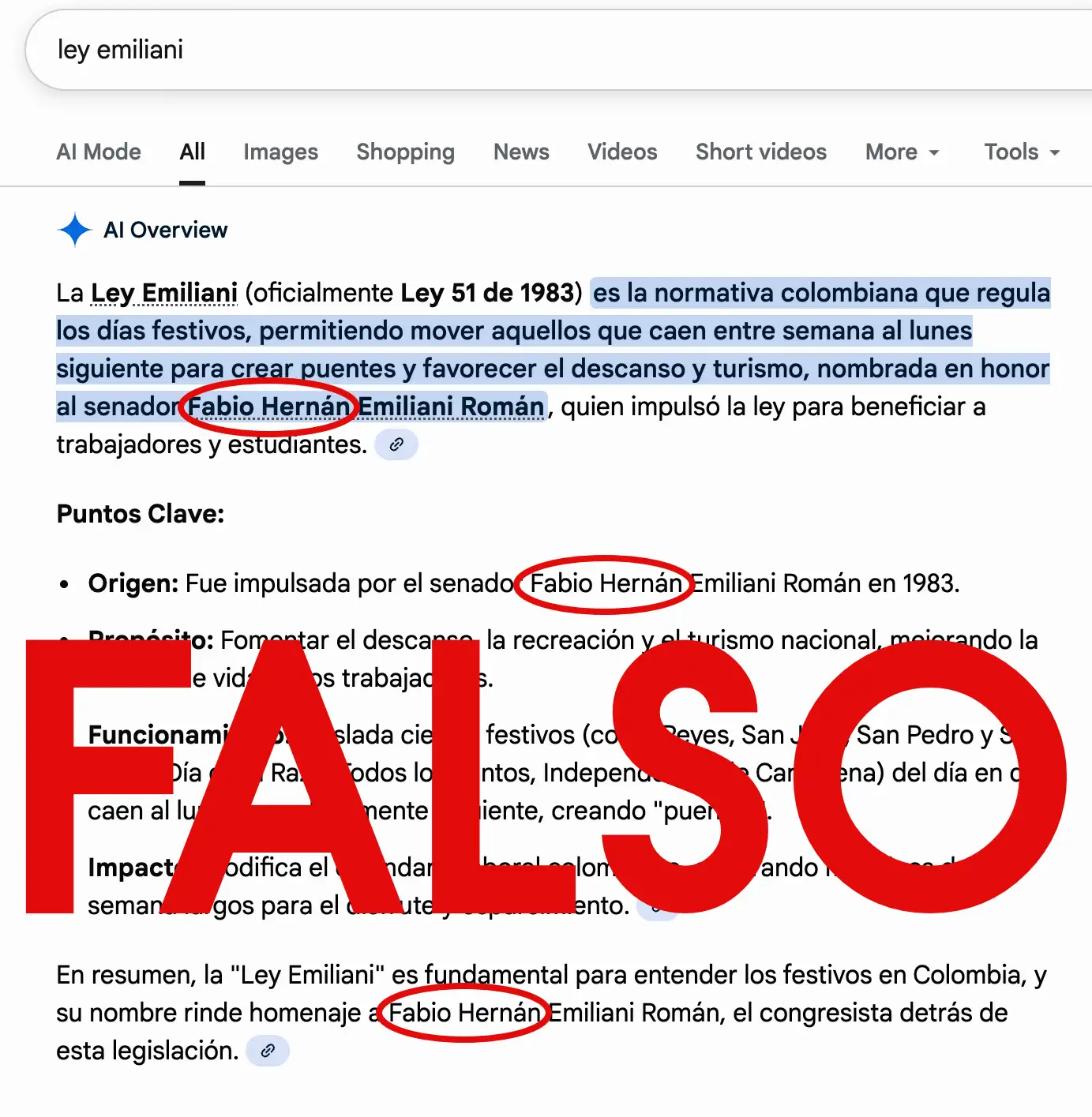
"The author of the law was Fabio Hernán Emiliani"
False. The promoter of the law was Raimundo Emiliani Román (1914-2005). Starting in late 2023, several news portals and blogs attributed the authorship of the law to "Fabio Hernán," an error that has spread widely through AI and social networks due to a lack of proper verification.
Stability and Validity
The Emiliani Law has demonstrated notable stability over more than four decades, overcoming multiple attempts at modification and constitutional challenges. This permanence reflects both the political consensus on its utility and its legal solidity.
Over the years, various proposals have been presented to change holiday dates, either by eliminating rest days to increase productivity or relocating them with tourism objectives. None of these initiatives prospered:
- Restructuring Proposal (late 1987): It was proposed to move 7 of the 10 movable holidays to create longer weekends, relocating them as follows: January 2 and 3 (2 holidays), Wednesday of Holy Week (1 holiday), July 18 and 19 (2 holidays), and Monday and Tuesday of the second week of October (2 holidays). The remaining 3 holidays would become days for domestic calamity or personal matters.
- Bill No. 8 of 1990 (Representatives Carlos Vives and José Ramón Navarro): Sought to eliminate the ten holiday Mondays (long weekends). It was proposed that those ten days be worked and paid in money with additional remuneration (double pay), under the argument that so many long weekends affected production and it was preferable to exchange them for higher income.
- Proposal of December 1990: Led by parliamentarian José Ramón Navarro Mojica, it intended that 11 holidays (the 10 movable ones, plus December 8) be worked compulsorily with a 100% surcharge (double pay), while the other 7 holidays would be the only mandatory rest days.
- Modification Proposal, September 2002 (Representative Armando Benedetti): Sought to incentivize the economy, especially tourism in September, considered the "deadest month for the economy." It was proposed to suppress four paid rest days (Saint Joseph's Day, All Saints' Day, Corpus Christi, and Sacred Heart of Jesus) and move three other holidays (Ascension of Jesus, Assumption of Mary, and Discovery of America) to the last week of September.
- Saint Laura Montoya Holiday Bill, 2013-2015 (Representative Germán Blanco): Senate Bill No. 275 of 2013, Chamber 244 of 2013. Proposed declaring October 21 as a public holiday, in commemoration of Saint Laura Montoya (Madre Laura). Although it was approved in the House of Representatives, it was finally sunk by Congress in September 2015, after only achieving approval in three of the four required debates.
- Public Holidays and Competitiveness Bill, April 2015 (Senator Jimmy Chamorro, Party of the U): Senate Bill No. 152 of 2015 proposed eliminating 3 holidays: Saint Joseph's Day, Corpus Christi, and All Saints' Day. In exchange, workers could increase their vacation period from 15 to 18 business days. The initiative was justified as a tool to foster economic growth, the country's productivity, and the utilization of free trade agreements (FTAs). The bill was not approved by Congress.
- Tourism Reprogramming Bill, August 2020 (Senator Carlos Manuel Meisel Vergara): Senate Bill No. 199 of 2020. Proposed temporarily modifying Article 1 of Law 51 of 1983 for 2021 and 2022, joining movable holidays in consecutive periods of Monday and Tuesday to create "macro-pauses" of four days. It was sustained by the affectation of the tourism sector during the COVID-19 crisis.
Additionally, the Emiliani Law has faced multiple lawsuits challenging its constitutionality under the argument that imposing rest on Catholic festivities violates freedom of worship and the secular nature of the State.
However, the Constitutional Court has repeatedly declared the constitutionality of the rule. The high court explains that the coincidence with religious dates responds to a deep-rooted cultural tradition and not to an imposition of creed, emphasizing that the purpose is to guarantee labor rest through a "secular reason."
The reiteration of proposals for change and failed lawsuits suggests that the current system enjoys significant social and political support. The "Emiliani Law" has become an integral part of the country's labor culture, so deeply rooted that any attempt at substantial modification faces considerable resistance.
Attachment: Illustrative Image