
Each year, most public holidays are observed on different dates than the previous year. This is why many people tend to acquire traditional almanacs or consult newspapers or websites to stay informed. But how exactly are public holiday observances calculated in Colombia?
This guide provides an easy way to understand how each of the 18 holidays is determined for any given year.
Public Holiday Categories
First, it is necessary to understand that there are 3 categories of holidays according to the way their date is calculated.
#1 Fixed-date holidays
These are the public holidays that are consistently celebrated on the same date each year.
Included:
- New Year's day
- Labor Day
- Independence Day
- Battle of Boyacá
- Immaculate Conception
- Christmas
#2 Holidays based on Easter
These holidays are determined by calculating the number of days before or after Easter Sunday, which varies annually. All of these holidays have a religious significance.
Included:
- Holy Thursday
- Good Friday
- Ascension Day
- Feast of Corpus Christi
- Feast of the Sacred Heart of Jesus
#3 Movable holidays (Emiliani)
These holidays are observed on the following Monday when their designated date falls on a day other than Monday. They are commonly referred to as holidays impacted by the "Emiliani Law" (Law 51 of 1983) which was implemented to boost tourism. These holidays include:
- Epiphany
- Saint Joseph's Day
- Feast of Saints Peter and Paul
- Assumption of Mary
- Columbus Day
- All Saints' Day
- Independence of Cartagena
Note: The holidays for the Ascension of Jesus, Corpus Christi and the Sacred Heart belong to category #2, but according to the law, they should also be moved to the following Monday. However, for calculation purposes, it is not necessary to take this into account because the rule of adding days from Easter Sunday ensures they fall on a Monday. Example 4 clarifies this situation.
Calculation Rules
In order to determine the date of any holiday for a specific year, it is essential to know its calculation category and reference date. Additionally, if the calculation is based on Easter Sunday, it is necessary to know the number of days that need to be added or subtracted to obtain the final date.
The table below illustrates the calculation required to determine the precise date of any holiday based on its category and reference date.
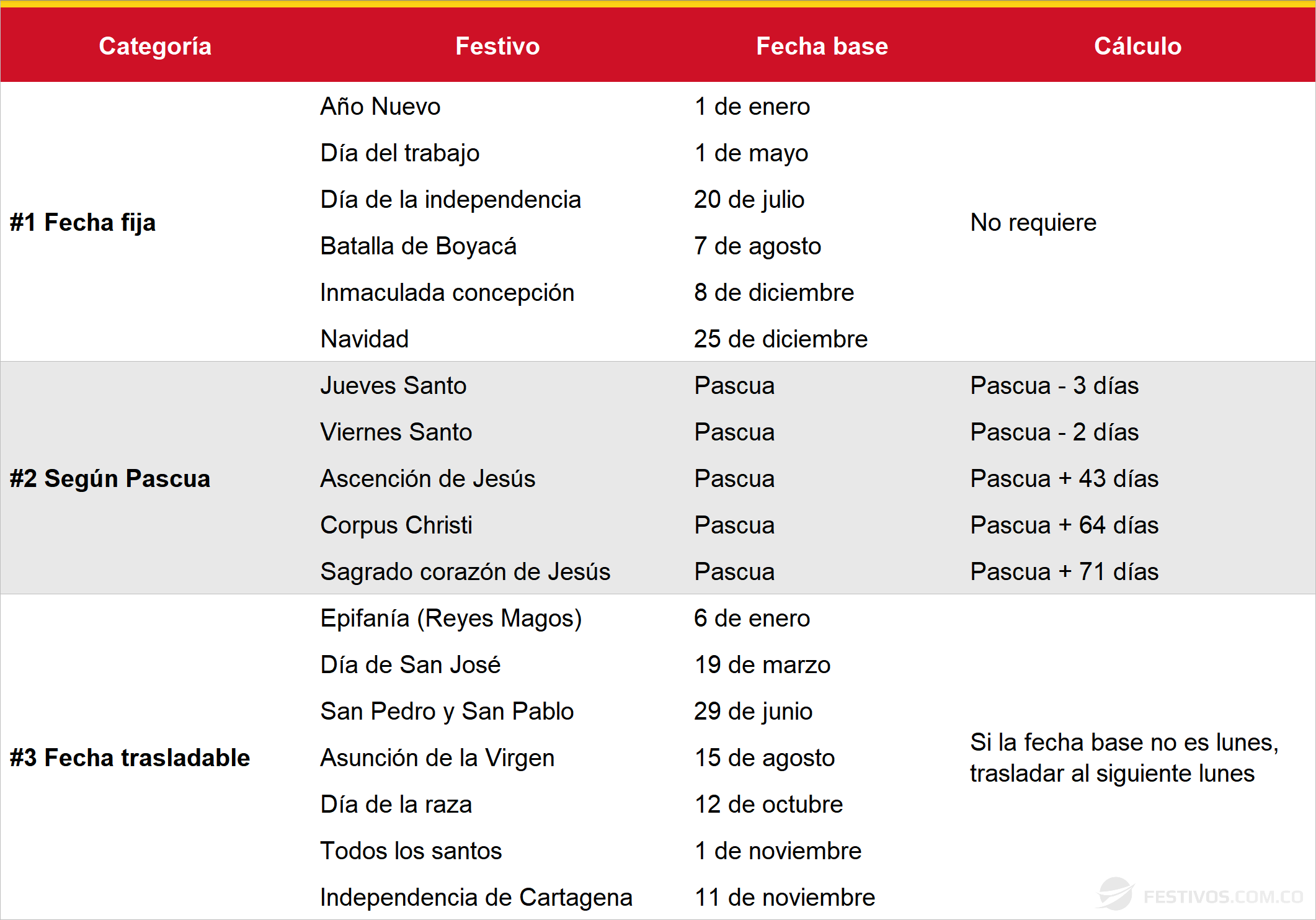
Easter Sunday Calculation
Easter Sunday, also known as Resurrection Sunday, typically varies from year to year as its calculation is based on the ancient lunisolar calendar. The method for determining its date has been consistent since 525 AD among Christians.
The rule states that Easter is the first Sunday following the first full moon after the vernal equinox. The vernal equinox is the point in the year when the duration of daylight and darkness are equal, based on the Earth's position.
Mathematical techniques have been developed to calculate the date of Easter in the Gregorian calendar, considering various factors in order to apply this rule. For example, while the vernal equinox can occur between March 19th and 21st, March 21st is always used as the reference date for calculation purposes.
In this way, the date of Easter can be determined using methods such as Gauss's algorithm.
To simplify the calculation of holidays in Colombia, the following list includes the pre-determined dates of Easter for several years:
Examples
The following examples illustrate steps to calculate a public holiday for year 2027. All calculations are performed using information table and pre-calculated Easter dates mentioned above.
Example 1: Determine the date of the 'Battle of Boyacá'
In this case, as the holiday falls under category #1 (Fixed Date), no calculation is necessary. The Battle of Boyacá holiday is observed on August 7th every year.
Example 2: Determine the date of observance of Good Friday
Good Friday belongs to category #2 and its date is determined by subtracting 2 days from the date of Easter Sunday.
Reference date: March 28 (Easter Sunday 2027)
Calculation: Subtract 2 days
Result: In 2027 Good Friday will be observed on March 26.
Example 3: Determine the date of observance of the Independence of Cartagena
Independence Day falls under category #3, which means it is traditionally observed on a Monday.
Reference date: November 11
Calculation: If the reference date is not Monday, move to the following Monday
Result: In 2027 the Independence of Cartagena will be observed on November 15.
Example 4: Determine the date of observance of Corpus Christi
According to the calculation table above, this holiday belongs to category #2 and is calculated by adding 64 days to the date of Easter.
Reference date: March 28 (Domingo de Pascua 2027)
Calculation: Sumar 64 días
Result: In 2027 the Corpus Christi public holiday will be observed on May 31.
⚠ Calculation details to consider
To accurately calculate this holiday in compliance with the legal requirements, it is necessary to divide the calculation process into two steps..
As per the church calendar, Corpus Christi falls 60 days after Easter Sunday. Then:
The partial result is May 27, which is the day on which the holiday is widely celebrated in many countries around the world, but not in Colombia
Now we have to verify if the date has to be moved to the following Monday based on the Emiliani law
May 27, 2027, will fall on a Thursday, thus the holiday is observed on the following Monday.
As Easter Sunday is always on a Sunday, adding 60 days will always result in a Thursday. This is why the calculation table specifies that 64 days should be added instead of 60, ensuring that the result is the following Monday without the need for additional calculations.
Considerations
The calculation method outlined here allows for the accurate identification of any holiday from 1984 onwards. For years prior to 1984, the rule for moving holidays to the following Monday does not apply as category #3 did not exist.
It is important to note that holidays are subject to changes by the government and the church.
Some holidays are celebrated on the same day in different countries and share similar calculation methods, however, this guide is only applicable specifically to Colombia.