2026 offers an exceptional opportunity with 15 puentes (long weekends), a historic record. However, having many public holidays does not automatically guarantee more rest. The key lies in knowing how to strategically combine them with vacation days.
With smart planning, legal vacation days can turn into much longer rest periods. This guide presents concrete, data-driven strategies to maximize vacations in 2026, adapted to personal preferences and circumstances.
The scenarios presented in this guide were generated by the Vacation Optimizer, which analyzes all possible combinations to find the exact strategies that maximize free time.
The Potential of 2026
The year 2026 will feature 15 long weekends, a record figure higher than the usual average. This opens up a range of possibilities for planning rest.
- The range of possibilities: With 15 vacation days, you can obtain from 26 days of rest in a single long period up to 61 days of total rest in the extreme case of distributing vacation days across 15 different periods.
- Top practical options: For most people, the most viable strategies result in 40 days (5 periods), 36 days (3 periods), or 26 days (1 period).
- The basic math: Maximization works by strategically adding vacation days to public holidays and weekends. The more distributed the days off are, the more weekends and long weekends you can take advantage of.
Best Long Weekends to Maximize Vacations
- Holy Week (April 2–5): The longest break with 4 calendar days (Thursday-Sunday), including Maundy Thursday and Good Friday.
- June's Holiday Trio (6–8, 13–15, 27–29): Three consecutive long weekends offering a unique opportunity to maximize June.
- Festive December (Dec 25 – Jan 1): Connecting Christmas and New Year's Day, this period allows for extended rest at the end of the year.
Best Alternatives
The optimal alternative to maximize vacations depends on personal preferences and circumstances, including the number of vacation days available, the date range in which they can be taken, and the number of periods over which they are preferred to be distributed.
Below are the main alternatives, using scenarios with 15 vacation days available in 2026 distributed across several periods.
Alternative 1: Distributed Vacations (5 periods)
Recommended for people who want to make the most of their available days, getting frequent breaks throughout the year.
Divided into 5 periods by taking vacation on:
-
January: Take 1 vacation day (January 2) to get 4 consecutive days of rest (January 1 to 4).
-
April: Take 1 vacation day (April 1) to get 5 consecutive days of rest (April 1 to 5). Also works by taking April 6.
-
June: Take 4 vacation days (June 9, 10, 11, and 12) to get 10 consecutive days of rest (June 6 to 15).
-
August: Take 5 vacation days (August 10, 11, 12, 13, and 14) to get 11 consecutive days of rest (August 7 to 17).
-
December: Take 4 vacation days (December 28, 29, 30, and 31) to get 10 consecutive days of rest (December 25, 2026 to January 3, 2027).
The first period can be replaced by another weekend close to a public holiday, such as May 4 to get 4 days (May 1 to 4). The others must be maintained to reach the maximum possible 40 days.
Advantages:
- Great optimization, taking advantage of multiple long weekends.
- Ideal for those who want short but frequent trips (every 2-3 months).
- Balance between optimization and frequency of vacations.
Disadvantage:
- Requires organization to take the 5 periods throughout the year, which may be less convenient for some.
Alternative 2: Balanced Vacations (3 periods)
This option is perfect for those seeking to balance significant trips with breaks distributed throughout the year.
-
March-April: Take 7 vacation days (between March 24 and April 1) to get 16 consecutive days of rest (March 21 to April 5).
-
June: Take 4 vacation days (June 9 to 12) to get 10 consecutive days of rest (June 6 to 15).
-
December: Take 4 vacation days (December 28 to 31) to get 10 consecutive days of rest (December 25 to January 3, 2027).
Advantages:
- Balance between number of periods and duration.
- Work approval is generally easier, with only 3 requests.
Disadvantage:
- Fewer total days of rest compared to the previous alternative (4 days less).
Practical Example: You could plan a long vacation during Holy Week, another mid-year, and a third for the end-of-year holidays, getting 10 more days of total rest than with a single period.
Alternative 3: Concentrated Vacations (1 period)
This alternative is ideal for people who prefer long trips, distant destinations, or a prolonged total disconnection.
Take the 15 vacation days in a single block between March 11 and April 1, taking advantage of Holy Week to extend the break until April 5.
The period can be adjusted slightly, provided it includes Maundy Thursday and Good Friday (April 2 and 3). Additionally, one can opt to take the 15 vacation days starting June 4, 5, or 9, taking advantage of that month's three long weekends (June's Holiday Trio) to obtain the same 26 days of total rest.
Advantages:
- Maximum disconnection from work.
- Ideal for planning long trips.
Disadvantages:
- Requires approval for a prolonged absence.
- Fewer total days of rest compared to the other alternatives.
- The whole year without intermediate breaks.
Practical Example: With this strategy, it is possible to take almost a full month to visit Europe, tour South America, or simply rest without thinking about work.
Other High-Maximization Alternatives (Less Practical)
There are strategies that achieve even more rest days, but their practicality decreases considerably.
- High distribution strategy (10 periods): Achieves 51 days of total rest. Requires organizing 10 different vacation periods, useful only for people with a lot of flexibility.
- Maximum distribution strategy (15 periods): Achieves 61 days of total rest, the absolute maximization. It implies taking a vacation day on each of the 15 long weekends. It is an extreme case, useful mainly to demonstrate the theoretical maximum or for freelancers with very specific needs.
Summary of Alternatives
These are the best alternatives to maximize vacations in 2026. All assume the use of 15 vacation days:
| Alternative | Total Rest | Best For |
|---|---|---|
| 1. Distributed (5 periods) |
40 days | Frequent regular breaks |
| 2. Balanced (3 periods) |
36 days | Balance between duration and number of trips |
| 3. Concentrated (1 period) |
26 days | Long international trips |
| Others (10-15 periods) |
51-61 days | Rare cases of workers with great flexibility |
Choosing the Right Strategy
Vacation planning is not just a math exercise to maximize days off. Work and personal factors influence the decision of which days are best for resting.
Company policies determine the real room for maneuver. If they require complex approvals, if other employees on the same team also plan to be away, or if some months are untouchable (fiscal closing, launches, audits), coordinating multiple periods can be difficult. Knowing these critical cycles allows you to propose dates that the employer would approve without resistance.
Personal aspects are also key. Family, school, or social events can change the whole picture. Likewise, when planning trips, tourist seasons or the weather can influence the choice of dates. The best strategy is not always the one that adds the most days, but the one that fits the energy level, personal responsibilities, and real need for disconnection.
An alternative to consider may also be not taking vacations and accumulating days for the next year. This can work for some people who don't need immediate rest or have enough with the 15 long weekends of 2026. 2027 will have only 12 long weekends and fewer opportunities to maximize vacations, so accumulating days might be wise.
There is also the possibility of negotiating payment for some untaken vacation days, if the company allows it. This is useful for those who need liquidity or prefer to wait for a year with better rest opportunities.
Common Mistakes When Planning Vacations
- Not coordinating with the company and the team: The absence may coincide with important activities such as accounting closures, launches, or vacations of other key people.
- Uncoordinated approval and trip planning: Asking for and obtaining vacation approval without defining a basic travel plan can lead to wasting valuable dates; conversely, planning and booking in detail before having company approval increases the risk of costly changes or cancellations.
- Overloading a single long trip: A very extensive block without intermediate pauses can generate fatigue and reduce the real benefit of rest throughout the year.
- Forgetting the budget impact: Some long weekends and high seasons allow for more days off but also imply higher transport and accommodation costs.
- Not leaving room for unforeseen events: When returning from a trip coincides immediately with returning to work, any flight delay, jet lag, or logistical setback can generate unnecessary stress.
Tool: Vacation Optimizer
The Vacation Optimizer is a tool that automatically calculates how to distribute vacation days to maximize rest time. It analyzes all possible combinations of public holidays, long weekends, and weekends in the year, and displays the most efficient strategies according to user preferences.
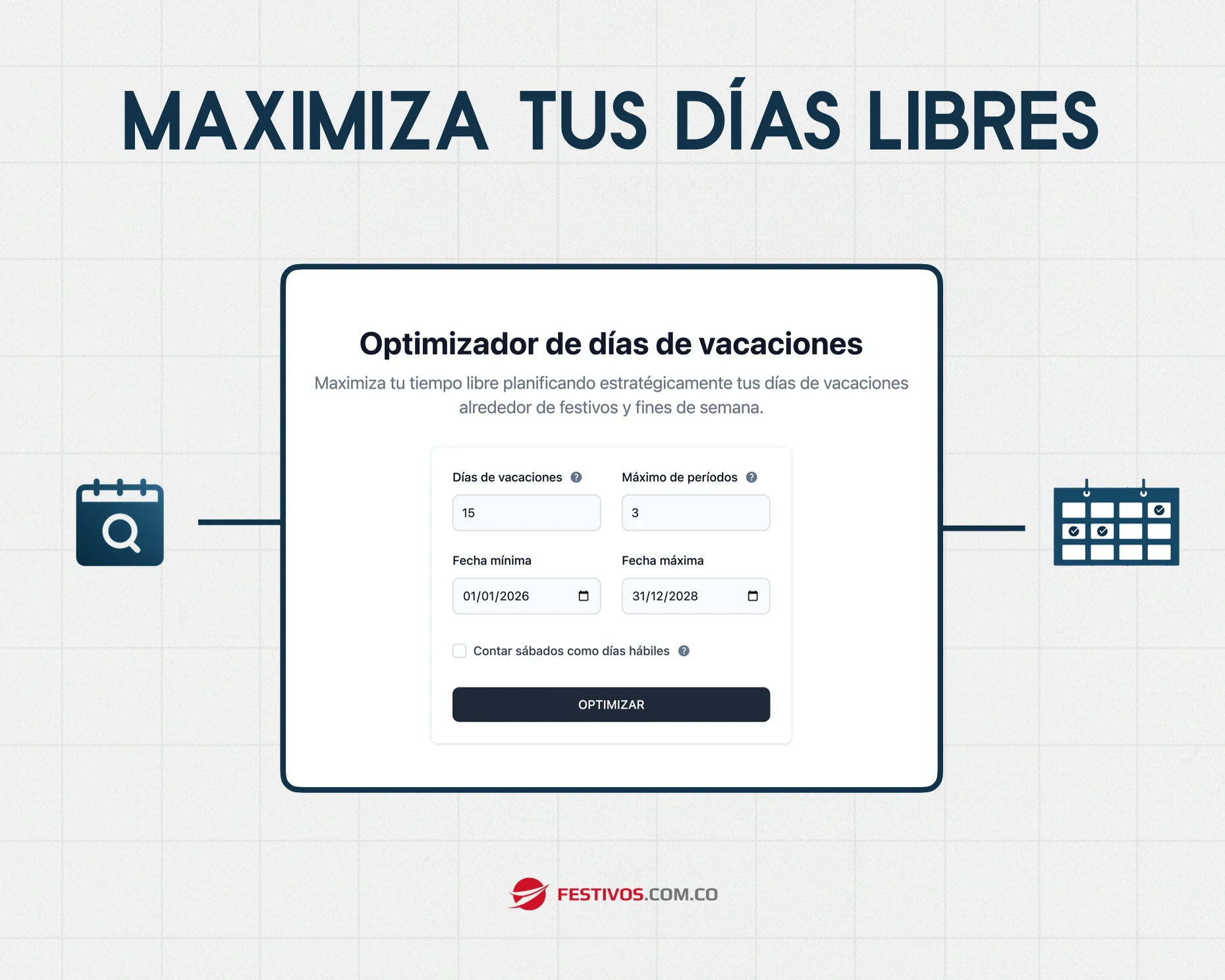
To use the optimizer, configure these basic values:
Vacation days available: Total number of vacation days that can be used in the analyzed period (for example, 15). The optimizer never exceeds this limit.
Max periods: Maximum number of blocks into which vacations are allowed to be divided. A value of 1 concentrates everything in a single period of consecutive days, while higher values can increase the total amount of rest days.
Date range: Interval in which vacations can be taken. The wider the range, the more opportunities there will be to find optimal combinations.
Count Saturdays as business days (optional): Option for companies where Saturday is considered a working day. When activated, Saturdays also deduct days from the total available vacation.
How to Interpret the Results
When pressing "Optimize", the tool shows an optimal solution: the maximum possible number of total rest days, how many vacation days are used, and in how many periods they are grouped.
In some cases, there is a single way to reach that maximum; in others, several different groupings of vacation days lead to the same result. For example, 6 vacation days can be distributed in 3 periods of 2 days each, or in 3 periods of 1, 1, and 4 days. When these alternatives exist, the Optimizer will show them so that each person can choose the combination that best fits their work and personal restrictions.
Practical Scenarios
Let's look at 3 practical scenarios for different types of people and needs.
Scenario 1: Planning a Trip Longer Than a Month
Situation: 20 vacation days accumulated for a long trip to Europe or Asia in a single period in 2026.
Planning: The optimizer shows multiple options at different times of the year to achieve the maximum number of continuous days:
- Take the 20 business days from March 4 to April 1, coinciding with Holy Week (Maundy Thursday and Good Friday) to extend the break until April 5.
- Take the 20 business days from June 5 to July 7, taking advantage of the three long weekends in June.
- Take the 20 business days from December 2 to 31, connecting with the Day of the Little Candles (Día de las Velitas, the unofficial start of Christmas), Christmas, New Year's, and even extending the break until January 3, 2027.
- The optimizer shows a total of 27 options that achieve the same result on different dates of the year.
Result: 33 continuous days of rest using 20 vacation days. View ↗
In this case, there are multiple alternatives to reach the maximum possible rest of 33 days in a single period, enough for a long trip and even touring several countries calmly.
Scenario 2: Converting 5 Vacation Days into 14 Days of Rest in December
Situation: 5 vacation days to take advantage of December and the holidays, divided into a maximum of 2 periods.
Planning: The optimizer suggests dividing the 5 days as follows:
- Period 1: Take 1 day (December 7) to connect with the Immaculate Conception holiday on the 8th → 4 consecutive days (December 5-8).
- Period 2: Take 4 days (December 28-31) → 10 consecutive days (December 25 to January 3).
Result: 14 days of total rest using only 5 vacation days. View ↗
A strategic distribution of a few days can significantly multiply rest time. The second period, covering Christmas and New Year's, especially increases the value of this combination.
Scenario 3: Flexible Long-Term Planning (2026–2029)
Situation: A person with the ability to plan vacations in advance, even several years ahead.
Planning: With 30 days available over a four-year span, to distribute in a maximum of 3 periods, the optimizer suggests:
- Period 1 (2026)*: Take 7 days (between March 24 and April 1) → 16 consecutive days (March 21 to April 5).
- Period 2 (2027): Take 2 days (March 23 and 24) → 9 consecutive days (March 20 to 28).
- Period 3 (2028): Take 21 days (between June 20 and July 21) → 29 consecutive days (June 17 to July 23).
*Period 1 can be replaced by a period in 2029, taking the 7 days between March 20 and 28 to get an equal 16 consecutive days of rest.
Result: 62 days of total rest using 30 vacation days. View ↗
This approach shows the maximum potential when there are no time constraints. It requires stability and foresight but allows for balanced breaks over several years.
Frequently Asked Questions
What are vacations?
Vacations are a mandatory paid rest period that every worker in Colombia is entitled to after providing services for one year.
How many vacation days correspond per year worked?
According to Article 186 of the Substantive Labor Code (CST), workers are entitled to 15 business days of paid vacation for each year of service.
Exceptions exist for some workers, such as those working with x-rays or in tuberculosis control, who are entitled to 15 days for every 6 months of service. There are also collective agreements or contracts that may grant more days, but never fewer.
Is it possible to split vacations into small periods?
Yes, but with restrictions. Article 190 of the CST establishes that the worker must enjoy at least six (6) continuous business days of vacation annually, which are not cumulative.
The remaining days can be accumulated for up to two years (or four years for technical, specialized, or employees in positions of trust closer to management in certain cases) or distributed by mutual agreement with the employer.
It is important to check each company's policies, as some may have additional rules or benefits.
Is it recommended to travel on every long weekend?
Long weekends (puentes) are usually times of high tourist demand, which can translate into high costs and crowded destinations. However, traveling during these periods also offers the advantage of maximizing rest time without using additional vacation days.
The recommendation is to evaluate each long weekend according to the destination, budget, and personal preferences. For some people, it might work to concentrate vacations in low-season months (like February, May, or September) to get better prices, and reserve long weekends for local rest or short road trips where costs are more controllable.
Can I receive payment instead of taking vacation?
Yes, it is possible to compensate a portion in cash. Article 189 of the CST allows the employer and worker to agree in writing on the payment in cash of up to half of the vacations.
They are also paid in cash when the employment contract ends without the worker having enjoyed their vacations; in this case, they are compensated proportionally for the time worked.
Complementary Resources
Resources to plan and make the most of vacations in Colombia:
- Vacation Optimizer: To find the best periods to take vacations.
- Long Weekends: Details of the long weekends.
- Calendar: Full year view with all public holidays.
- Business Day Calculator: To count business days between two dates.